

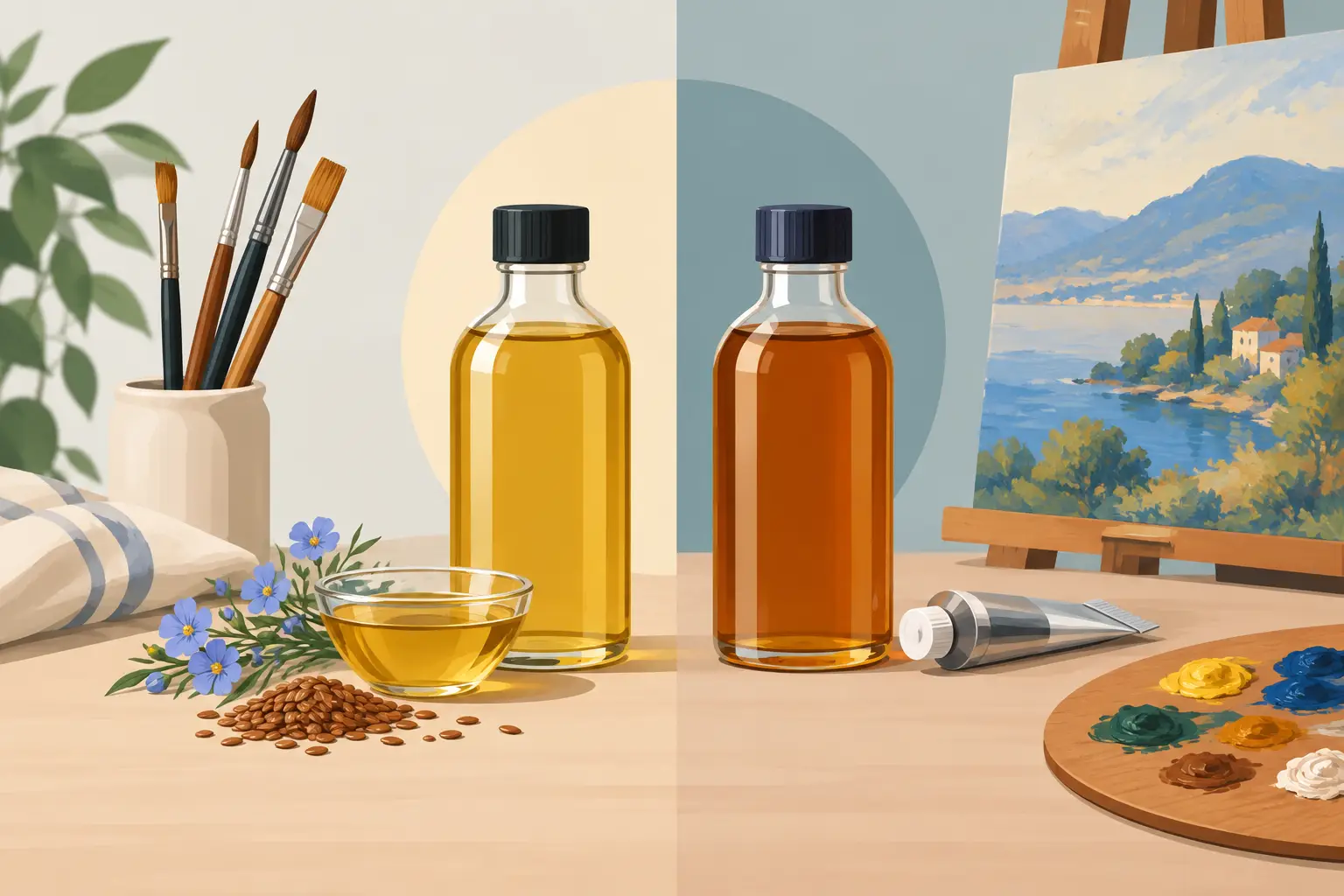
A painting can be transformed by a medium long before the final varnish is considered. A passage that needs to remain open for soft transitions asks different things of the paint than a quickly completed study, a glazing sequence or a tightly layered portrait. In the question of linseed oil versus alkyd, neither material is simply better. Each changes the working feel, drying rate and optical character of oil colour, and each asks for a slightly different approach to building a sound paint film.
The useful choice is not between ‘traditional’ and ‘modern’. It is between the handling and drying behaviour the picture requires.
Linseed oil versus alkyd: the essential difference
Linseed oil is a drying vegetable oil pressed from flax seed. It is one of the principal binders of traditional oil paint, valued for its agreeable handling, refractive richness and capacity to form a strong, flexible film as it cures. It dries by oxidation: oxygen from the air reacts with the oil, gradually converting the liquid material into a solid network.
Alkyd is a synthetic resin, usually modified with drying oils so that it remains compatible with oil painting practice. Alkyd mediums and alkyd oil colours also cure through oxidation, but they are formulated to set and cure considerably faster than linseed oil. Their purpose is not merely speed. They can alter brush resistance, level brushmarks, increase gloss and help layers become touch-dry on a more predictable timetable.
Both are oil-based painting materials, but their character in use is distinct. Linseed oil generally extends working time and produces a softer, more yielding brush feel. Alkyd tends to give paint a shorter, silkier pull and a faster set. That difference has consequences for blending, glazing, layering and the rhythm of the studio.
What linseed oil brings to the palette
A modest addition of linseed oil increases flow and transparency without introducing a solvent-heavy feel. It is particularly useful when colour needs to move more freely across the surface, when a brushstroke should retain a supple edge, or when a glaze needs depth rather than a thin, underbound appearance.
Its optical effect matters. Oil has a refractive index closer to that of many pigments than air does, so it can deepen the apparent saturation and transparency of a colour. Dark passages may appear richer, while transparent earths and lakes can gain luminosity. This is one reason oil-rich glazes have such visual authority.
The trade-off is drying time. A layer made more oil-rich will usually remain workable longer and may take appreciably longer to become touch-dry. Thickness, pigment, temperature, humidity and light all affect this. Earth colours often set more readily than colours based on certain organic pigments, while a heavily applied oil-rich mixture will behave differently from a thinly brushed one.
Linseed oil can also increase gloss and, if used excessively, leave a film that is more prone to wrinkling, yellowing or uneven drying. More medium is not automatically better medium. Professional oil colour is already carefully balanced between pigment and binder; in many applications, the smallest useful addition is the right one.
Refined, cold-pressed and stand oil
Not all linseed oils handle alike. Refined linseed oil is a familiar general-purpose choice, usually pale and free-flowing. Cold-pressed linseed oil may have a more pronounced character and colour, depending on its preparation. Stand oil, which has been heat-bodied, is far more viscous and produces smooth, enamel-like levelling when diluted appropriately.
These variations are not interchangeable. Stand oil is often chosen for controlled glazing and reduced brushmark texture, rather than for broad, immediate painting. A painter seeking direct, responsive handling may prefer a less viscous oil or no added medium at all.
What alkyd changes in practice
Alkyd answers a practical problem familiar to any painter working in layers: the need to continue before a conventional oil layer has had several days to settle. A thin alkyd-modified layer can often become touch-dry overnight, though this should never be treated as a fixed guarantee. Studio temperature, application thickness and the particular colour mixture remain significant.
This faster set is valuable for painters making successive glazes, working to a deadline, travelling with studies, or returning to a painting in short sessions. It can reduce the period in which wet layers are vulnerable to disturbance, dust and accidental marking.
Alkyd mediums often improve flow and levelling while preserving more body than a solvent-rich mixture. They can make a paint layer feel more deliberate under the brush: less open than linseed oil, but not necessarily less expressive. For some painters, that slight resistance supports crisp edges and economical marks. For others, especially those blending flesh tones or skies over extended sessions, it may feel too quick.
Alkyd can also produce a relatively glossy surface. This may suit transparent passages and saturated darks, but pronounced differences in sheen across a picture can make judgement difficult while painting. Where possible, keep the medium approach consistent within related areas, rather than alternating between very lean, matt passages and highly glossy alkyd-rich ones without purpose.
Drying is not the same as curing
A surface may be touch-dry while the underlying film continues to cure. This distinction is essential when working quickly with alkyd. Touch-dry means the paint can often accept a careful subsequent layer; it does not mean that all chemical change has finished.
For sound layer construction, observe the principle commonly called fat over lean. Earlier layers should generally be leaner, meaning less oil-rich and more rapidly setting, than the layers above them. Subsequent layers may contain a little more medium or oil, retaining enough flexibility as the painting ages.
Alkyd does not remove the need for this discipline. Its rapid setting can make it easier to progress through a painting, but it is still sensible to avoid placing a slow, oil-rich layer beneath a quicker, leaner layer that may restrict it. Keep mixtures purposeful, apply thin layers where possible, and allow each stage sufficient time before making demanding additions.
Which medium suits your method?
Choose linseed oil when extended manipulation is central to the image. It is well suited to wet-into-wet work, gentle transitions, open brushwork and glazing where a rich, traditional oil handling is desired. It can be especially rewarding when the painting process is unhurried and each layer is allowed to develop on its own timetable.
Choose alkyd when the schedule of the work matters as much as the surface. It is often a sensible option for layered realism, small studies that must be handled soon, repeated glazing, or painters who prefer a paint film to settle promptly. It can also help when a colour feels too stiff but a large addition of solvent would make the passage too lean.
Many experienced painters use both, but not indiscriminately. A painter might use a small amount of alkyd medium in an early, thin block-in to establish a stable working surface, then use a restrained oil-rich medium in selected later glazes. Another might use linseed oil throughout and reserve alkyd for work that must dry between sessions. Consistency within a particular painting is usually more valuable than collecting mediums for every possible effect.
Colour, pigment and surface still lead the decision
Medium cannot be considered apart from pigment and ground. A naturally transparent pigment may need little help to produce a luminous glaze, while an opaque colour may become merely slippery if overloaded with oil. Fast-drying earth pigments and slower-drying colours will not respond identically to the same medium. The absorbency of the ground also affects whether paint appears sunken, glossy or uneven.
Begin with the paint itself. High-pigment professional oil colour offers a broad range of handling before any medium is introduced. Test a small addition on the palette, compare the mark beside unmodified paint, and note whether the medium has genuinely improved the passage. The aim is not to make every colour behave the same way, but to understand what each colour can do.
If a painting develops patchy gloss, do not automatically add more medium to every mixture. The cause may be an absorbent ground, an underbound application, uneven thickness or the differing absorbency of previous layers. Material decisions are most reliable when they respond to the actual surface rather than a general rule.
A measured approach to medium use
Use either linseed oil or alkyd sparingly at first. Mix only enough for the session, keep tools clean, and avoid returning contaminated medium to its container. Record useful combinations in a studio notebook: colour, proportion, ground, application thickness and drying conditions. Over time, this becomes more reliable than a universal recipe.
For painters refining a serious palette, Michael Harding oil colours are made to offer strong pigment presence and considered handling directly from the tube. Medium should therefore be a precise adjustment, not a substitute for paint quality or a way to force every pigment into identical behaviour.
The best medium is the one that allows the painting to proceed with clarity. If your brush needs time, choose the openness of linseed oil. If the next layer needs to happen tomorrow, let alkyd earn its place. In either case, use enough to serve the image, and no more.