
A medium is not simply something added to make oil colour go further. Oil mediums alter the physical character of the paint: its flow, transparency, gloss, drying rate, brush resistance and, ultimately, the structure of the paint film. Used with intention, they give a painter more control. Used indiscriminately, they can weaken colour, create uneven surfaces or complicate later layers.
For many paintings, the most disciplined choice is also the simplest: use paint largely as it comes from the tube, then introduce a medium only where a particular passage calls for it. A finely made oil colour already contains the oil needed to bind its pigment. The question is not whether a medium is essential, but what you need it to do.
What oil mediums actually do
Oil colour is pigment dispersed in a drying oil, most commonly linseed oil, though safflower and walnut oils are also used in certain colours. As the oil absorbs oxygen, it polymerises into a solid paint film. A painting medium adds more binder, modifies that binder, or combines it with other materials to change handling.
This distinction matters. Turpentine and odourless mineral spirits can thin paint, but they are solvents rather than true binding mediums. As they evaporate, they leave no binder behind. In an early, lean layer this may be useful, but excessive solvent can leave too little oil to form a sound, coherent film. A medium, by contrast, generally contributes to the binding structure as well as changing consistency.
The effect is never one-dimensional. More oil may improve flow and make a colour more transparent, but it can also increase gloss, deepen the appearance of darks and slow drying. An alkyd medium can speed drying and increase body or fluidity, depending on its formulation, but may produce a surface quality different from a paint layer made with oil alone. The appropriate choice depends on the painting method, the layer beneath and the surface you want to see.
Choosing oil mediums by the result you need
Start with the mark, rather than the name on the bottle. Are you trying to draw a thin, mobile line? Soften a transition without scumbling? Build a luminous glaze? Keep a broad brushstroke open for longer? Each purpose suggests a different material behaviour.
For greater flow and levelling
Refined linseed oil increases fluidity, gloss and transparency while retaining a traditional feel under the brush. It can be especially useful for deliberate, enamel-like passages and transparent layers, where brushmarks are not the main event. It is not the quickest-drying option, and it may yellow more noticeably than paler oils, particularly in whites and very light mixtures kept away from light.
Stand oil is linseed oil that has been heat-bodied. It is thicker and more stringy than refined linseed oil, yet it levels remarkably well when used sparingly or diluted within a suitable medium. Painters often value it for smooth glazing and reduced brushmark, but its slower drying character means it rewards patience. It is rarely the best answer for a fast, direct painting session.
Walnut oil is valued by some painters for its pale colour and supple handling. It can be a considered choice in light passages, although drying behaviour varies with formulation, pigment and environmental conditions. No oil should be added simply because it seems gentler or more natural. It still changes the balance of the paint film.
For faster drying and a more immediate process
Alkyd mediums are useful when working in successive layers over several days rather than several weeks. They can increase flow, promote quicker drying and often provide a resilient, glossy film. Gelled alkyd mediums also allow painters to retain more body than a very fluid medium would permit.
The trade-off is speed. A passage that becomes touch-dry quickly may leave less time for blending, feathering and revising wet into wet. Alkyd mediums can suit a painter who works in distinct sessions, but they may feel restrictive to someone making slow tonal adjustments across a whole canvas. Use the smallest effective amount, and test it with your usual colours before committing it to a major work.
For body, texture and visible brushwork
Not every medium should make paint runnier. Gel and impasto mediums can increase volume, hold brushmarks and support palette-knife work while allowing the painter to extend a colour without simply adding more pigment-rich paint. They are practical where material presence is part of the image.
However, a raised passage should be structurally considered, not merely expressive. Very thick applications dry from the surface inward and may remain vulnerable beneath a dry skin for some time. Build impasto with materials intended for the purpose, avoid excessive thickness in a single application and allow ample drying between substantial stages.
Fat over lean is a working principle, not a slogan
The familiar rule of fat over lean is a way of managing flexibility between layers. Leaner layers contain relatively less oil and tend to dry sooner; fatter layers contain relatively more oil or medium and remain more flexible. Applying a lean, fast-drying layer over a fatter, slower-moving one can create stress as the lower layer continues to change.
In practical terms, begin with paint that is minimally modified, or with a small amount of solvent where your method requires a lean first stage. As the painting develops, reduce solvent and introduce more oil-rich or alkyd medium if needed. This does not require a ritual of ever-more-complicated recipes. It asks only that each new layer is not more brittle or faster-drying than the one beneath it.
There are exceptions and variables. A direct painting completed wet into wet behaves differently from a layered painting built over months. Highly absorbent grounds can pull oil from the first paint layer, altering its appearance and handling. Individual pigments also dry at different rates: earth colours often dry readily, while some blacks, lakes and whites can be slower. Material decisions work best when observed in the actual studio, not treated as fixed formulae.
Mediums and colour: what changes on the palette
Adding medium inevitably changes the pigment concentration of a colour. This can be useful in a glaze, where transparency and optical depth are wanted, but it is less helpful when a passage depends on the covering power of a dense opaque colour. A medium cannot create more pigment strength. It can only alter how that pigment is distributed and how the mark sits on the surface.
Gloss is equally significant. Oil-rich and alkyd-rich passages may appear darker and more saturated than matte or solvent-thinned areas. If this difference is part of the painting’s language, use it consciously. If it is not, inconsistent gloss can make it difficult to judge values while working. A reserved approach to medium, combined with a consistent ground and thoughtful layer structure, usually produces a more predictable surface.
This is one reason a limited palette rewards close material knowledge. Once you understand how your particular ultramarine, earth red, white and black respond to a chosen medium, you can anticipate drying, transparency and sheen rather than correcting them after the fact. Michael Harding oil colours are formulated with a high pigment load, so even modest additions of medium can produce a clear and useful shift in handling.
A disciplined studio method
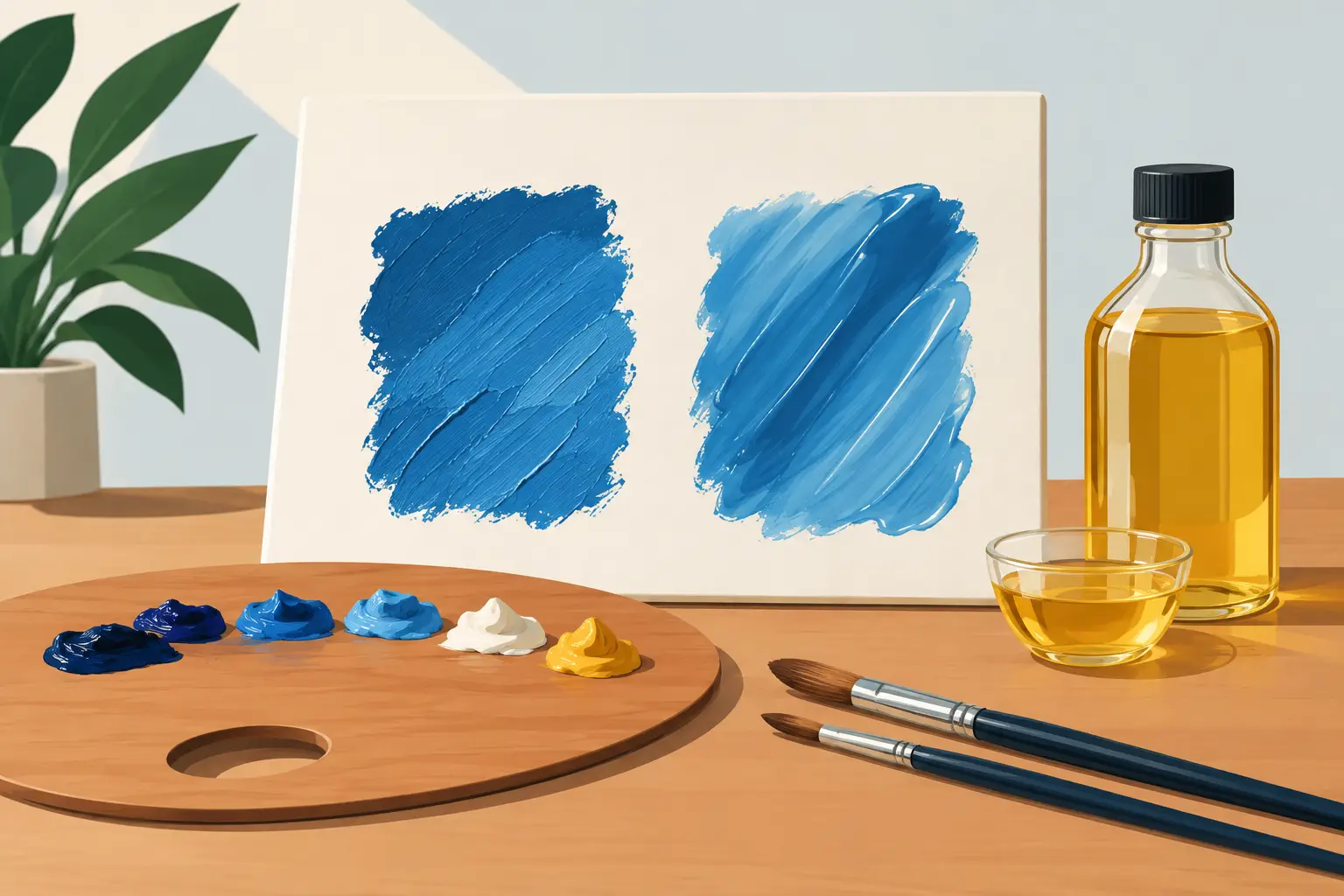
Rather than premixing a large bottle of medium for every purpose, place a small amount in a separate dish and introduce it selectively with the brush. Keep one area of the palette for unmodified paint. This lets you compare the colour’s native handling with the altered mixture and prevents an entire session from becoming more fluid or glossy than intended.
Make test swatches on the same primed surface used for your painting. Label the colour, the medium and the approximate proportion. Observe the swatches immediately, after a day, and again once fully dry. Look for changes in gloss, wrinkling, sinking in, transparency and brushmark. These modest records become more reliable than general advice because they describe your pigments, your ground and your working conditions.
Avoid adding a medium out of habit. If paint feels stiff, first ask whether a firmer brush, a different mark or a smaller adjustment in paint consistency would serve the passage better. If a colour has sunk in, assess the absorbency of the ground and the condition of the layer before reaching for more oil. Mediums are precise tools, not a remedy for every technical difficulty.
When less is the better choice
Many enduring oil paintings rely on remarkably little added medium. Tube colour, carefully placed and allowed to retain its natural body, can offer opacity, texture and a directness that no mixture improves. This is particularly true in early block-ins, opaque modelling and passages where the distinct character of each pigment matters.
Choose a medium when it gives a specific advantage: a cleaner glaze, longer open time, faster turnover between layers, softer transitions or a more deliberate surface. Then let the needs of the next mark determine the quantity. The most useful medium is often the one that disappears into the painting, leaving the colour, structure and judgement of the work fully present.