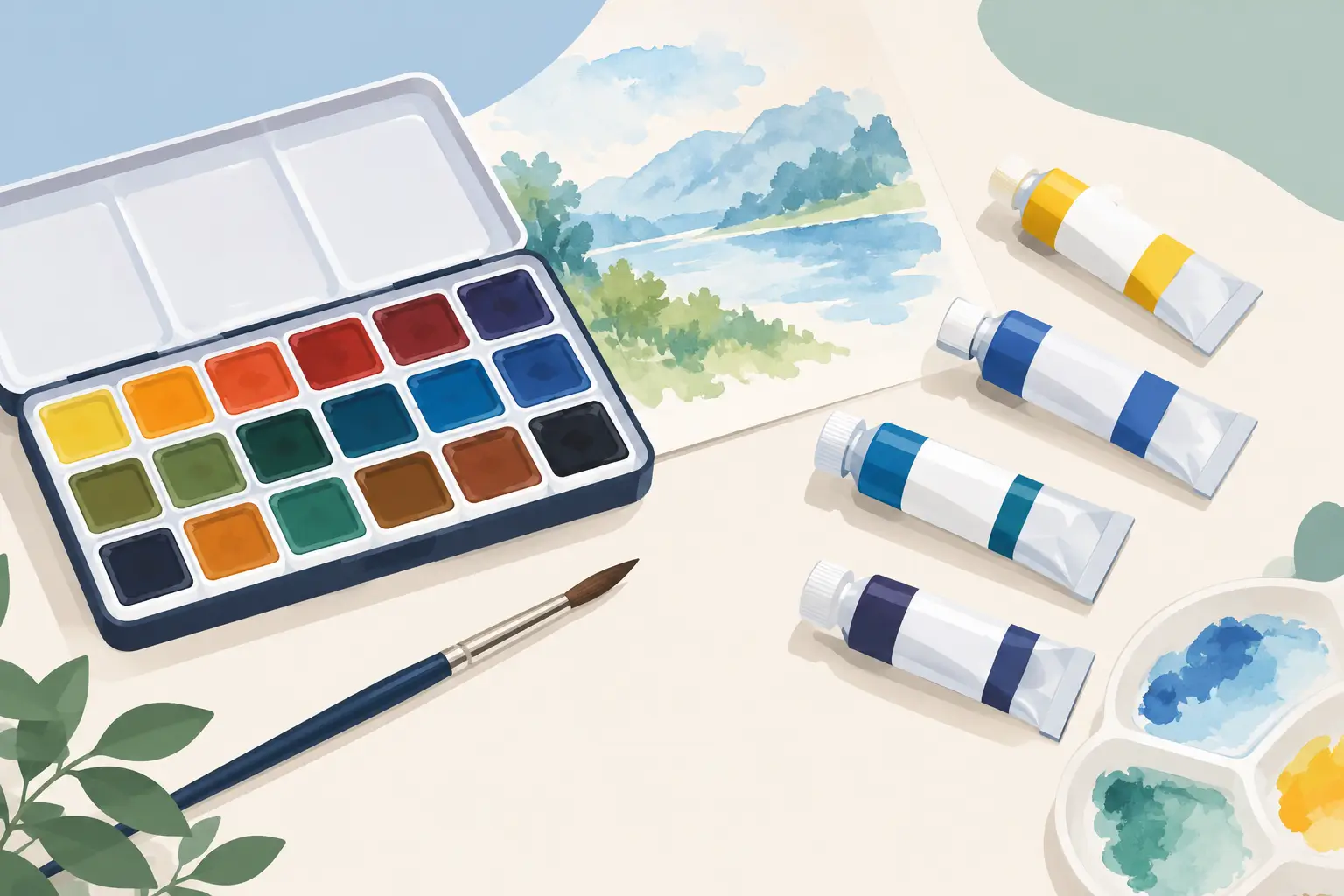
A tightly organised colour box and a generously loaded ceramic palette can contain the same pigments, yet they ask very different things of the painter. The question of pan versus tube watercolours is not simply one of convenience. It affects the scale of a wash, the pace of mixing, the amount of water under your control and, ultimately, how you build a working relationship with colour.
Neither format is inherently more professional. A finely made watercolour should offer strong colour, clean dilution and dependable handling whether it begins in a pan or a tube. The better choice is the one that serves your painting method rather than forcing that method to adapt.
Pan versus tube watercolours: the essential difference
A pan is watercolour that has dried into a small mould, usually a half pan or full pan. You activate its surface with a damp brush, gradually gathering colour and adjusting the dilution as you paint. Tube colour is moist paint. It is squeezed into a palette well, where it can be used immediately or allowed to dry for later rewetting.
This distinction matters most when you need a particular volume of colour. A pan excels when you want repeated access to a controlled amount of a familiar hue. A tube allows you to prepare a substantial, even mixture before the brush reaches the paper.
The paint itself deserves closer attention than the format. Look first at the pigment or pigments used, transparency, staining behaviour, granulation, lightfastness and the character of the colour in mixtures. A single-pigment earth yellow will not behave like a bright, staining organic yellow simply because both are supplied in pans. The format changes access and workflow; pigment remains the heart of the decision.
What makes pans appealing
Pans reward restraint and familiarity. Their compact form makes them practical for sketching outdoors, travelling, classes and any situation where a limited, carefully considered palette is useful. A half-pan box can hold a wide range of colours without taking over the working area, and the colours remain in a fixed order from one session to the next.
They also make it easier to work in small quantities. For botanical studies, pencil-and-wash sketches, small landscapes and measured layering, a damp brush lifted across a pan can provide exactly enough colour. The gradual process of loading the brush encourages painters to observe dilution closely rather than beginning with too much paint.
A well-filled pan is durable. It is difficult to spill, simple to transport and ready after a brief misting or a touch of clean water. If you work intermittently, pans remove the minor decision of whether yesterday's palette has dried too hard or gathered dust.
There are limits. Loading a large brush from a pan takes time, particularly with thirsty natural-hair brushes or broad wash brushes. It can also be difficult to prepare enough of a pale, even mixture for a sky or background. Repeatedly scrubbing the same pan with a very wet brush may create a stronger mixture than intended before there is enough volume to complete the passage.
When tubes earn their place in the studio
Tube watercolours are especially useful for paintings with expansive washes, assertive darks or repeated mixtures. You can place a generous amount of colour in a clean well, add measured water and mix enough for the entire area. This reduces the risk of having to remake a wash halfway across a sheet, where even a well-matched mixture may dry with a visible change in tone.
They suit painters who mix deliberately from a reduced palette. With a few carefully selected pigments, tubes make it easy to prepare related pools of colour: a warmer neutral for the foreground, a cooler variation for distance, then a deeper version for accents. The palette becomes a working space for colour relationships rather than merely a place to pick up paint.
Fresh tube colour is also useful when you want very concentrated passages. Dense darks, saturated details and heavily granulating mixtures can be prepared quickly. That said, forceful colour is not automatically better colour. Watercolour gains much of its luminosity from dilution, the white of the paper and the painter's ability to preserve clean passages.
The practical drawback is quantity. It is easy to squeeze out more paint than a small study requires. Tube colour can be allowed to dry and reactivated, but a palette left uncovered is exposed to studio dust and accidental contamination. A little discipline helps: begin with small amounts, place colours consistently and add more only when the scale of the painting demands it.
Rewetting, drying and colour strength
Good watercolour is designed to rewet, but not every pigment responds at the same speed. Earth colours often release readily. Some highly staining colours can appear reluctant when fully dry, then yield a strong wash once worked with a damp brush. Granulating pigments may need a little more mixing on the palette to distribute their particles evenly.
This is why a judgement based on the first touch of a dry pan can be misleading. Give the surface a moment to take up water, then load the brush with intention. Equally, do not mistake the glossy appearance of freshly squeezed tube paint for an assurance of greater pigment strength. Strength depends on the formulation, pigment and dilution, not on whether the paint is wet in the tube.
Many painters create their own pan sets from tubes. This offers an effective middle course: choose the colours and pan arrangement you need, fill in several thin applications, then allow each to settle before adding more. Avoid filling a pan to the brim in one go. A gradual fill is less likely to overflow and gives the paint time to dry evenly.
For a serious palette, this approach can be more useful than buying colours in both forms. Keep frequently used mixing colours in tubes for the studio, and use a selected range of dried tube colour in a travel box. The same pigment knowledge can then follow you from a large sheet at the easel to a sketchbook outdoors.
Choose by painting scale and working rhythm
If your paintings are small, observational and mobile, begin with pans. Select a restrained group of colours with distinct mixing roles rather than a crowded box of near-duplicates. A warm and cool bias in the primaries, an earth or two, and a dependable dark may be more revealing than a large collection chosen by name alone.
If you regularly paint on full sheets, work wet into wet, or make broad washes, tubes will usually make the process calmer. There is no virtue in trying to coax a large wash from a half pan when the painting calls for a prepared pool of colour. The time saved can be spent judging edges, values and the movement of water on the paper.
For many artists, the most satisfactory answer is both. A pan set offers consistency and portability; tubes provide volume and freedom in the studio. Michael Harding watercolours are made with the same commitment to pigment character that should guide this choice: understand what each colour does, then choose the format that lets it do that work well.
A practical way to test your preference
Use one familiar subject twice, preferably on the same paper. Paint a small version from pans, paying attention to how easily you can make pale washes, lift stronger colour and return to a mixture. Then paint a larger version using tube colour in a palette, preparing each principal wash before you begin.
Notice more than speed. Did one method make you overmix? Did you hesitate before a broad wash because there was not enough colour ready? Did a compact set help you make cleaner decisions, or did it restrict the range of dilution you wanted? Your answers will be more useful than a general rule.
A watercolour palette should support attention, not compete for it. Choose pans when their order and economy help you see clearly; choose tubes when the painting needs generous mixtures and room for colour to move. Then let the pigment, the paper and the subject lead the next decision.