










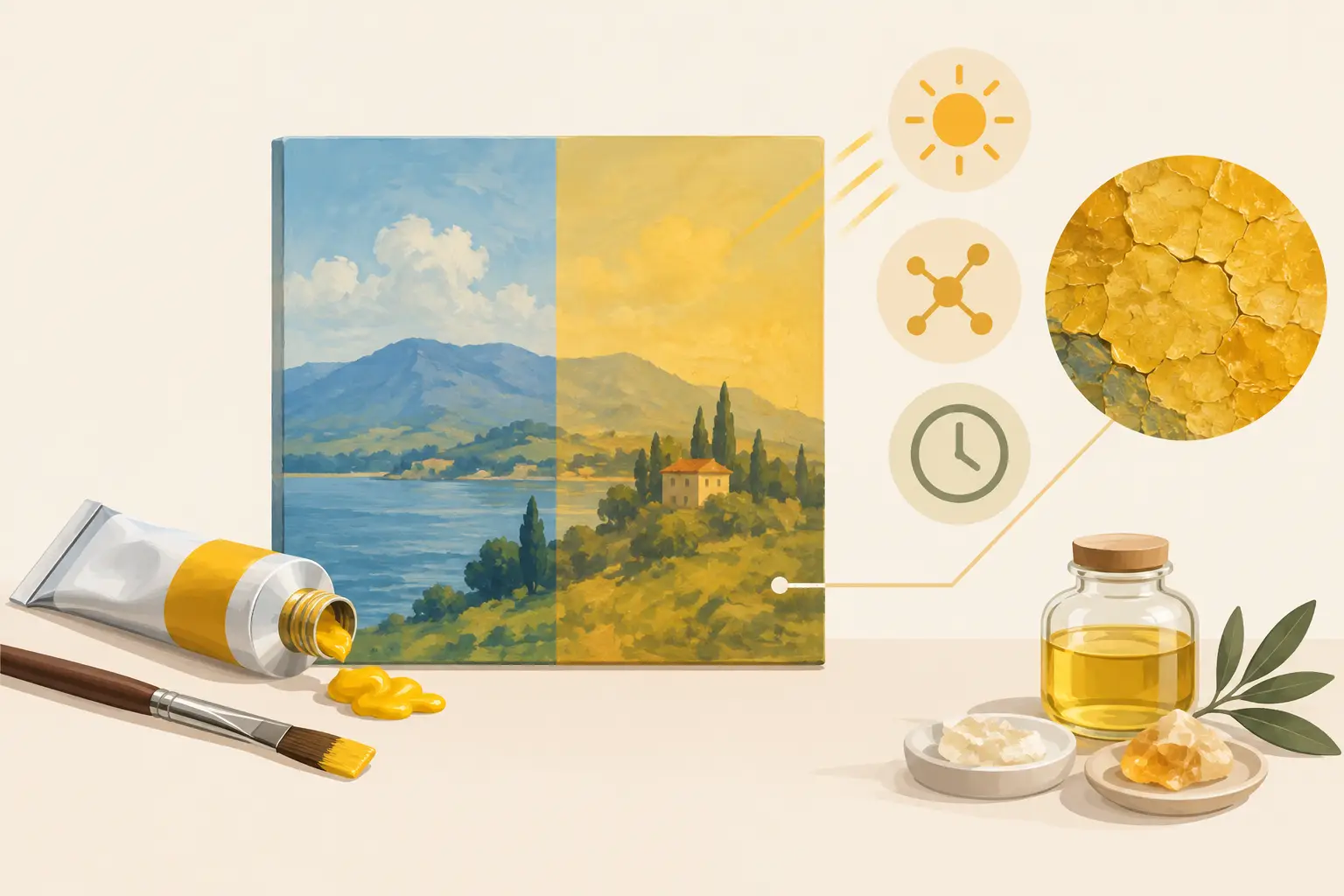
A painting can look noticeably warmer after months in a cupboard, on a studio rack or beneath a temporary cover. A pale sky shifts towards cream, a white passage loses its clean edge, and cool greys begin to feel subdued. So, why does oil paint yellow? Usually, the change begins not with the pigment but with the oil binder - and particularly with the way that binder has been stored, exposed to light and allowed to age.
Oil paint is not a static material. Its appearance develops as the paint dries and continues to mature. Understanding which changes are temporary, which are inherent to particular materials and which signal a conservation issue gives painters more control over both palette and practice.
Why does oil paint yellow in darkness?
The most familiar form of yellowing is associated with drying oil, especially linseed oil. As oil paint cures, the oil undergoes a complex process of oxidation and polymerisation, forming the durable paint film that holds pigment to the surface. In low light or darkness, some oxidation products that contribute to a yellow cast can accumulate or become more visible.
This is often most apparent in whites, very pale tints and mixtures containing plenty of white. A small degree of warmth that would be imperceptible in a dark green may be obvious in a passage of pale blue-grey. It can also be more conspicuous where paint has been applied generously, as thicker passages contain more binder and dry more slowly through their depth.
The encouraging point is that darkness yellowing is frequently reversible, at least in part. When a sound, fully dry painting is returned to ordinary daylight, the paint film may bleach back towards its original appearance over days or weeks. This is not an instruction to place a painting in fierce direct sun. Excessive light is harmful to many pigments and can accelerate other forms of ageing. Rather, normal, indirect daylight can help reverse the temporary yellow cast associated with dark storage.
This behaviour explains why a painting removed from a drawer, wrapped for transport or stored face-inward against another work can initially appear more yellow than remembered. Before making drastic decisions about repainting or restoration, allow it time in moderate ambient light.
The role of the drying oil
Not all oils behave identically. Linseed oil has long been valued by painters for its strong, durable paint film and dependable drying character. It does, however, have a naturally warmer cast than paler oils, particularly as it ages. This is a material property rather than a defect, and it should inform decisions about pale passages and whites.
Safflower and poppy oils are generally paler than linseed oil and have traditionally been used in some whites and light colours. Their paleness can be attractive, but every oil brings its own handling and drying considerations. A slower-drying oil, for example, affects the pace of layered work and the behaviour of a paint film over time. There is no universally superior choice: the best binder depends on the colour, the method and the artist’s priorities.
The quantity of oil also matters. A well-made oil colour requires sufficient binder to wet and hold the pigment, but an unnecessarily oily mixture can produce a more translucent, glossy or yellow-prone surface. Adding excessive medium, oil or solvent to compensate for stiff paint can upset the balance of the formulation. It may also create uneven gloss, underbound passages or layers that do not age together gracefully.
For pale mixtures, use the smallest amount of medium that serves the painting. If a fluid application is needed, choose a medium deliberately and keep its use consistent across the passage, rather than repeatedly enriching the paint on the palette.
Pigment can change the way yellowing is seen
Pigments do not all respond to light, oil and ageing in the same way. White pigments make any change in the binder highly visible because they reflect so much light. Titanium White is particularly opaque and bright, so a creamy shift in its surrounding oil film can be readily noticed. Zinc White, when used, creates different structural considerations and should not be chosen simply as a means of avoiding yellowing.
Some historical pigments have an inherent tendency to alter over time. Lead White may develop changes in certain environments, particularly where sulphur-containing gases are present. Cadmium colours, ultramarine and earth pigments each have distinct material characteristics, yet the apparent warming of a mixed colour is often less about a dramatic pigment failure than about the oil film lying around and between the pigment particles.
This is why pigment knowledge remains central to a reliable palette. A single-pigment colour lets the artist understand more clearly what is influencing tinting strength, opacity, drying and colour shift. In a complex convenience mixture, it can be harder to identify whether a change comes from the pigment combination, the binder or a previous layer beneath it.
Varnish, dirt and ageing are different problems
Not every yellowed painting is suffering from oil yellowing. Aged natural-resin varnishes can darken and discolour markedly, sometimes turning a cool painting visibly amber. Surface dirt, cooking residues, smoke and atmospheric deposits can also dull highlights and suppress the clean separation of colours. These changes sit on or above the paint surface; oil-binder yellowing occurs within the paint film itself.
The distinction matters. A varnish problem may be addressed by a trained paintings conservator, whereas temporary darkness yellowing may improve with suitable light exposure. Attempting to remove old varnish without the right knowledge can damage original paint, disturb delicate glazes or leave irreversible abrasion. Never treat a yellowed surface with household cleaners, oils or improvised solvents.
A recently varnished painting can look warmer simply because the varnish deepens saturation and alters surface gloss. This is not necessarily yellowing, but it is one reason to test varnish on a study or a discreet edge before committing it to a finished work. Ensure the paint is properly dry and cured for the chosen varnishing method, and use a varnish intended for artists’ paintings.
How to reduce avoidable yellowing
You cannot remove all ageing from an oil painting, nor should you expect an oil-bound white to behave like a freshly printed sheet of paper. The aim is to make informed material choices and avoid conditions that exaggerate change.
Store finished paintings where they receive some ordinary ambient light, while protecting them from prolonged direct sunlight, damp and extremes of heat. Avoid leaving work in complete darkness for extended periods where possible. If paintings must be stored, keep them upright, protected from dust and separated so that painted surfaces do not touch one another.
Build layers with sound oil-painting practice. Begin with stable, properly prepared supports; avoid excessively absorbent or poorly sealed grounds; and observe a sensible fat-over-lean progression where layers become incrementally more flexible as the painting develops. These principles do not prevent all yellowing, but they support a more coherent paint structure.
For passages where a cool, high-key effect is essential, make a test. Paint the intended mixture on the same ground, at a comparable thickness, and retain it as a studio reference. Observe it wet, touch-dry, after several months and after a period in low light. A small test panel can reveal more about a specific combination of pigment, white, medium and ground than a general rule ever can.
When yellowing deserves expert attention
A uniform, mild warmth that improves in daylight is usually a material behaviour to observe rather than panic over. Localised brown patches, cracking, blanching, tackiness, a strong odour, lifting paint or a dramatically discoloured varnish are different matters. They may indicate moisture exposure, failing layers, contamination or an unsuitable past treatment.
If the work is valuable, historic or structurally unstable, consult a qualified paintings conservator before doing anything to the surface. Good conservation begins with diagnosis. The same principle serves the practising painter: look closely, identify the layer in which the change is occurring, then choose the least intrusive response.
Oil paint rewards patience because its beauty is inseparable from its material life. A little yellowing need not diminish a painting; often, it is a temporary reminder that pigment, oil, light and time are still in conversation on the surface.